
Theme & Domains of Research

The Five Pillars of the Society

The Society is founded upon an integrated interdisciplinary framework consisting of five core pillars :  Smell, Sensors, Signal, Simulation, and Systems which collectively define the scientific, technological, computational, translational, and societal dimensions of modern olfaction science and allied innovations. These pillars provide a unified framework for advancing research, education, healthcare applications, intelligent sensing technologies, artificial olfaction, environmental monitoring, and next-generation AI-enabled olfactory systems.
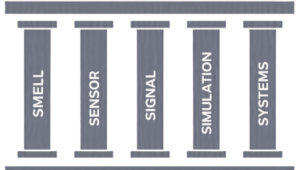
Each pillar encompasses a broad spectrum of scientific disciplines, technological innovations, and emerging research domains, thereby enabling the Society to function as a comprehensive platform for interdisciplinary collaboration and innovation.

1. Smell

The Smell pillar represents the foundational science of olfaction, chemosensation, odor perception, and volatile chemical communication. It focuses on understanding how biological systems detect, process, interpret, and respond to chemical stimuli in the environment. This pillar encompasses molecular, cellular, physiological, neurological, cognitive, behavioral, and clinical aspects of olfactory science.

Scientific Domains

Olfactory biology and physiology, Chemosensory science, Neuroscience of smell and perception, Olfactory receptor biology, Neurocognition and sensory processing, Odor psychophysics and perception, Human and animal olfaction, Volatile organic compound (VOC) science, Smell and emotion interactions, Flavor and fragrance science, Clinical olfaction and smell disorders, Olfactory biomarkers and disease signatures, Environmental odor science, Social and behavioral chemosignaling.

Technology Domains

Digital odor profiling, Smell characterization platforms, VOC detection technologies, Olfactory diagnostic platforms, Aroma and flavor analysis systems, Smell databases and olfactory atlases, Electronic olfaction interfaces.

Research Areas

Disease-associated breath biomarkers, Smell loss and neurological disorders, Cancer biomarker identification, Human odor signatures, Food quality and spoilage detection, Precision olfaction and personalized diagnostics, Olfaction in mental health and cognition, Olfactory communication systems.

2. Sensors

The Sensors pillar focuses on the development, optimization, integration, and deployment of sensing technologies capable of detecting odors, volatile compounds, biomarkers, environmental cues, and chemical signatures. It includes both biological and artificial sensing mechanisms and emphasizes innovation in hardware, materials, nanosystems, and intelligent sensing platforms.

Scientific Domains

Sensor science and engineering, Nanotechnology and nanomaterials, Analytical chemistry, Surface chemistry, Bioelectronics, Biomaterials and biosensing, Molecular recognition systems, Semiconductor and MOS technologies. 

Technology Domains

Electronic nose (E-nose) systems, Nano-sensor arrays, MEMS and microfluidic sensors, Gas sensors and VOC sensors, Biosensors and wearable sensors, Flexible and smart sensing devices,Point-of-care diagnostic devices,  Optical, electrochemical, and acoustic sensing systems, IoT-enabled sensing systems, Smart environmental monitoring devices.

Research Areas

Breathomics and breath analysis,  Non-invasive disease diagnostics,  Smart wearable healthcare systems, Agricultural and livestock sensing, Industrial safety monitoring, Food authenticity and quality assessment, Environmental pollution detection, Sensor fusion and multimodal sensing, Low-cost portable diagnostic devices.

3. Signal

The Signal pillar addresses the acquisition, processing, interpretation, integration, analysis, and intelligent utilization of olfactory and sensor-derived data. It bridges sensing technologies with computational analytics and decision-making systems, enabling transformation of raw chemical or biological information into meaningful scientific and actionable insights.

Scientific Domains

Signal processing, Data science and analytics, Statistical modeling, Pattern recognition, Bioinformatics and computational biology,  Information theory, Machine perception, Biomedical data analytics. 

Technology Domains

AI-enabled signal analytics, Feature extraction platforms, Pattern classification systems, Multimodal data integration, Real-time analytics pipelines, Cloud-based sensing analytics, Edge AI and embedded intelligence, Big data platforms, Decision-support systems, Explainable AI frameworks.

Research Areas

Odor pattern recognition, Biomarker signal interpretation, AI-driven disease prediction, Multisensor data fusion, Temporal and spatial odor analytics, Predictive healthcare systems, Behavioral and environmental signal analytics, Sensor drift correction and calibration, Adaptive signal intelligence systems.

4. Simulation

The Simulation pillar focuses on computational modeling, artificial intelligence, machine learning, predictive analytics, digital olfaction, and virtual representations of olfactory processes and sensory systems. It serves as the computational backbone of modern olfaction science and supports predictive, scalable, and intelligent system development.

Scientific Domains

Artificial intelligence, Machine learning and deep learning, Computational neuroscience, Mathematical modeling, Computational chemistry, Systems biology, Cognitive computing, Digital twin technologies.

Technology Domains

Digital olfaction platforms, AI/ML prediction systems, Virtual smell modeling, Computational odor simulation, Neural network architectures, Large language and multimodal models, Reinforcement learning systems, High-performance computing, Virtual and augmented olfactory interfaces.

Research Areas

AI-based smell prediction, Computational olfactory modeling, Disease prediction through VOC signatures, Generative odor modeling, Olfactory digital twins, Smart simulation environments, Autonomous sensing intelligence, AI-assisted healthcare diagnostics, Predictive environmental monitoring, Human-machine olfactory interaction.

5. Systems

The Systems pillar represents the integration of biology, sensing technologies, signal intelligence, computational frameworks, software ecosystems, devices, and deployment infrastructures into complete functional solutions capable of addressing real-world challenges. This pillar emphasizes translation, scalability, deployment, interoperability, and societal impact.

Scientific Domains

Systems engineering, Biomedical engineering, Cyber-physical systems, Translational science, Human-centered system design, Healthcare systems, Networked intelligence systems.

Technology Domains

Integrated E-nose systems, AI-driven healthcare platforms, IoT-enabled smart systems, Cloud-integrated sensing ecosystems, Real-time diagnostic systems, Decision-support infrastructure, Edge computing architectures, Smart city and environmental systems, Telemedicine and remote diagnostics, Digital healthcare ecosystems.

Research Areas

End-to-end olfactory diagnostic systems, Smart healthcare deployment platforms, Precision medicine systems, Autonomous environmental intelligence, Industrial and agricultural automation, Human-AI collaborative systems, Integrated biomedical monitoring platforms, Translational olfaction technologies, Regulatory-ready diagnostic ecosystems, Scalable public-health sensing systems.

Integrated Vision of the Five Pillars

Together, the five pillars create a comprehensive ecosystem for advancing olfaction science from basic discovery to societal deployment. The framework enables integration of: biological understanding, intelligent sensing, computational analytics, artificial intelligence, simulation technologies, and real-world systems engineering.

This integrated approach positions the Society to lead global advancement in: digital olfaction, intelligent sensing, AI-enabled diagnostics, environmental intelligence, precision healthcare, computational smell science, and future human-machine olfactory interaction systems.